A house rental vs hotel for a family reunion of 20 people comes down to three numbers: nightly rate, fees, and meals. On lodging alone, hotel group rates can win. Add a shared kitchen and one-roof logistics, and a house usually costs less per person. A house plus a few hotel rooms often does too.
Key Takeaways
- Compare checkout totals for the same dates, not nightly rates, because cleaning fees, service fees, taxes, resort fees, and parking change the result.
- A house tends to win when the group stays several nights, cooks together, and wants shared space. Hotels tend to win for one-night stays or relatives who pay their own way.
- A group of 20 typically needs 8 to 10 standard hotel rooms, and many rental homes sleep fewer than 20 people.
- A hybrid plan, with most of the group in one house and the overflow in nearby hotel rooms, often gives the lowest total.
- Split costs by person-nights so relatives who stay fewer nights or bring fewer people pay a fair share.
- Ask hotels for a room block, a cutoff date, and written cancellation terms before you promise relatives a rate.
If you are the one asked to solve this, you may have typed something like: Can you help me figure out if we should do a house rental vs hotel for our family reunion? We have 20 people and want to minimize costs. The question has a clear answer, but it depends on arithmetic most guides skip.
James and I spent five years hosting groups in Destin, Florida before opening Glencairn Knoll in La Grange, KY. The same budget questions come up in nearly every reunion inquiry we answer.
This 2026 guide runs a same-dates comparison for 20 people. It covers fees, room counts, cost splitting, and group-rate requests. Prices are ranges from published budgeting guides that vary by city and date, so confirm exact quotes for your dates.
Is a House Rental vs Hotel Cheaper for a Family Reunion of 20?
A house rental vs hotel comparison for 20 people is a per-person calculation. Take total lodging and fees plus food, then divide by headcount and nights. Hotel group rates often win on bedrooms alone. A house tends to win once meals and shared space are counted. Fewer reservations help too.
Published reunion budgets put large rentals sleeping 20 to 30 people at roughly $800 to $2,000 per night. That works out to about $40 to $100 per person per night for 20 guests. Hotel group rates in the same guides run roughly $89 to $129 per room.
Hotels look cheaper on that single line. But a hotel bill does not include a kitchen, a living room big enough for everyone, or a place where cousins can stay up late without bothering other guests.
For one night, hotels usually win. For two to four nights with shared meals, a house is usually the cheaper plan. A house-plus-hotel hybrid is usually cheaper too. Treat these figures as starting points and run your own numbers.
What Costs Should You Compare Before Choosing?
The costs to compare are the base nightly price, cleaning and service fees, lodging taxes, resort and parking charges, and food. Nightly rates alone mislead, because fees land differently on a house than on a block of hotel rooms.
| Cost factor | House rental | Hotel rooms |
|---|---|---|
| Base nightly price | Roughly $800-$2,000 for a home sleeping 20-30 | Roughly $89-$129 per room at a group rate |
| Cleaning fee | Often $75-$200 per stay | Usually folded into housekeeping |
| Platform service fee | About 14% of the subtotal on many booking platforms | None |
| Lodging tax | 10-18% depending on the city | 10-18% depending on the city |
| Resort fee and parking | Parking typically free on the property | $0-$45 resort fee and $0-$55 parking per night |
| Meals | Groceries and a full kitchen | Breakfast included at many hotels |
| Housekeeping | Guests tidy up or pay extra | Daily and included |
These table values are ranges from published budgeting guides, and they vary by city and date. Request an itemized quote from each option for identical dates. Compare the final totals, then divide by 20.
Are Airbnbs Cheaper Than Hotels for a Big Group?
Airbnb and Vrbo rentals are often cheaper than hotels for large groups because one nightly rate covers many beds. They are rarely cheaper for couples or single-night stays, where fixed fees weigh more heavily.
The cleaning fee is charged once per stay, so a one-night reunion feels it more than a four-night one. Minimum-night rules can also force you to pay for a night you do not need.
AirDNA reports that Louisville short-term rentals average about $217 per night across all sizes in 2026. A home built for a dozen or more guests typically prices higher, so do not anchor on that average.
Booking directly with the host skips the third-party platform service fee. Ask for an all-in quote that includes cleaning and taxes so you can compare it fairly against hotel totals.
What Is It Called When You Rent a House Instead of a Hotel?
Renting a house instead of a hotel is called a vacation rental or short-term rental. An “entire home” listing on Airbnb or Vrbo means your group has the whole property to itself, with no host or other guests sharing the space.
For 20 people, the value is in what comes with the house: a full kitchen and a washer and dryer. Several living areas and parking at the door add to it. Linens and towels are normally provided, but confirm that for your group size.
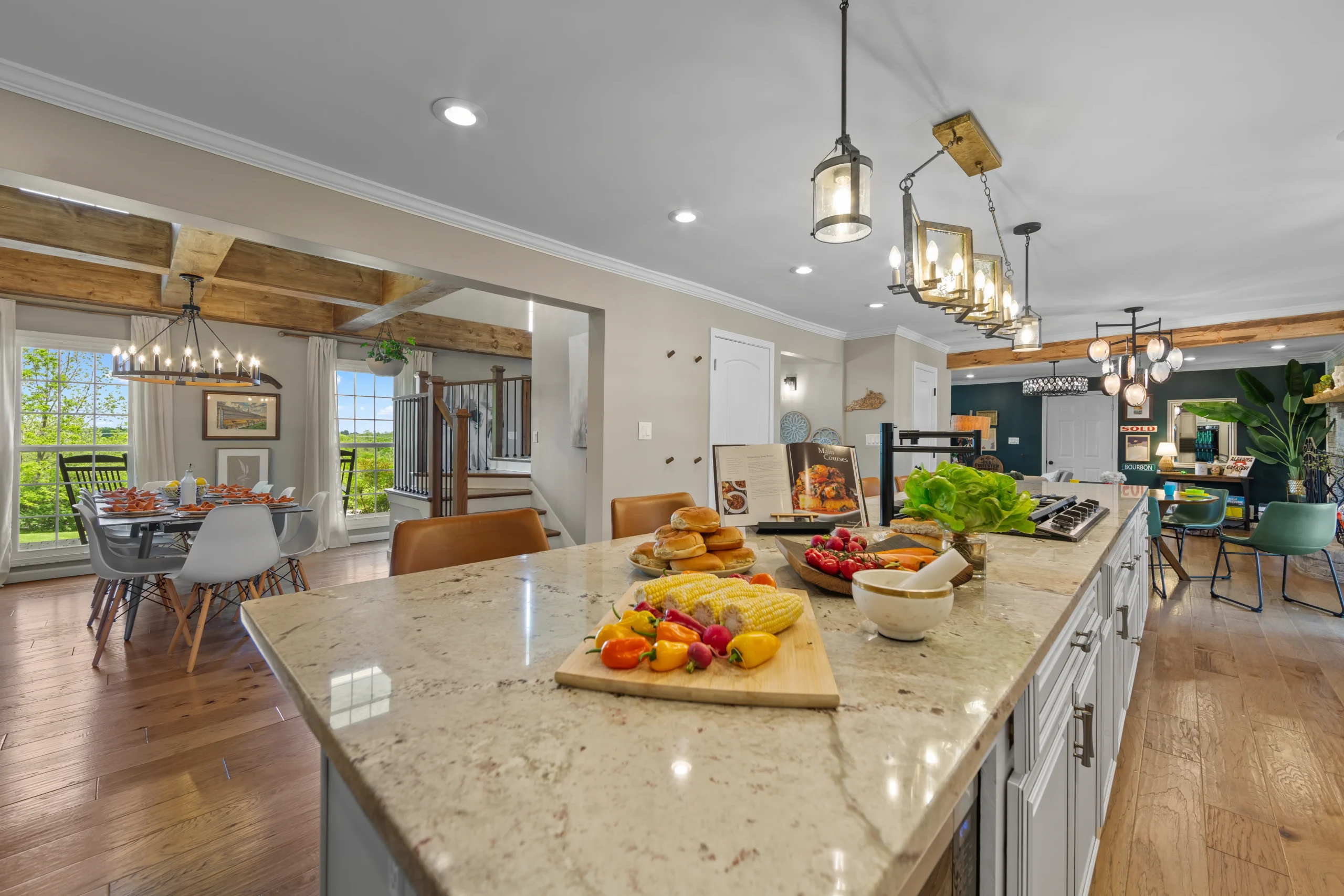
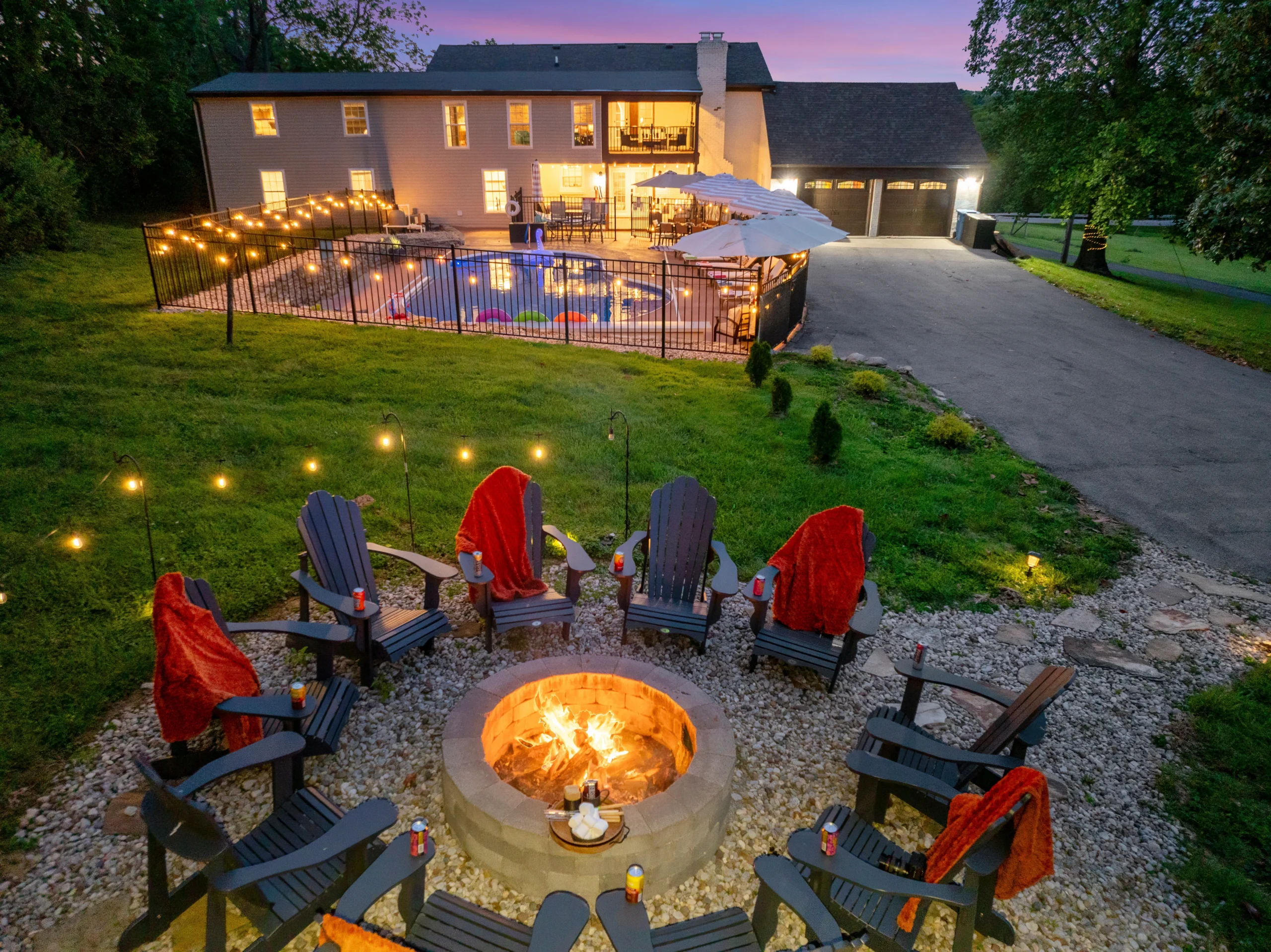
At Glencairn Knoll, the chef’s kitchen was built for cooking for a crowd, with an island where people drift in and out all morning. Guests also have a heated saltwater pool and a covered hot tub. There are two game rooms and a fire pit as well. If a pool matters to your reunion, look at this guide to a Louisville-area rental with a heated pool.
A hotel pool is shared with other guests and closes at set hours. A private one does not.
How Many Hotel Rooms Does a Group of 20 Need?
A group of 20 typically needs 8 to 10 standard hotel rooms. Couples share one room, and families with two children usually need one room with two beds. Solo adults or teenagers may need their own.
Here is one realistic mix: four families of four fill four rooms, two couples fill two more, and four singles take two or four. That lands between 8 and 10.
Using the group-rate range from the table, 8 rooms cost about $712 to $1,032 per night. Ten rooms cost about $890 to $1,290. That is roughly $35.60 to $64.50 per person per night before tax, parking, and food.
Hotels have trade-offs beyond price. Adjoining rooms are hard to guarantee, and your group may end up on different floors. Gatherings spill into hallways or someone’s room, and quiet hours apply to everyone.
Can One House Sleep 20, or Do You Need a Hybrid Plan?
A hybrid reunion plan puts most of the group in one rental house and the overflow in nearby hotel rooms. It is often the cheapest way to keep 20 people close together without paying for 10 rooms.
Verify capacity before you book. Count actual beds and bathrooms, not the advertised guest number. Glencairn Knoll has four bedrooms, five king beds, and four bathrooms. A queen sleeper sofa in the speakeasy lounge brings the maximum to 12 guests.
For a group of 20, that leaves about 8 people for 3 or 4 hotel rooms. At the group-rate range above, that adds roughly $356 to $516 per night. Ask the hosts for a quote for your dates, then add that figure.
Two house rules matter here. Only registered guests may use the property, and events are not permitted. Tell the hosts your final headcount, and clear any daytime visitors with them in advance.
If your priority is sleeping all 20 under one roof, a different house will serve you better. Glencairn Knoll is a fit when 12 or fewer will stay overnight.
How Do You Split Lodging Costs Fairly Among Relatives?
Splitting by person-nights means dividing the total lodging bill by the combined number of nights every guest stays. It treats a relative who stays two nights differently from one who stays four, so nobody subsidizes anyone by accident.
- Get the full checkout total, including cleaning fees and taxes.
- Multiply each person’s nights by one, then add everyone together.
- Divide the total by the combined person-nights.
- Multiply that rate by each person’s own nights.
Here is a hypothetical example. A house costs $2,400 in total. Eight people stay 3 nights (24 person-nights) and four people stay 2 nights (8 person-nights). That is 32 person-nights, or $75 each. The three-night guests pay $225 and the two-night guests pay $150.
Decide how to treat young children before you send the numbers. Many families charge children a reduced share or nothing. Collect deposits before booking, and agree up front who absorbs a cancellation.
How Much Does Feeding 20 People Change the Math?
Meals are the biggest swing factor in a reunion budget, because a rental kitchen turns restaurant bills into grocery bills. Published budgets for groups of 20 to 40 often land at roughly $75 to $150 per person for a weekend. That covers lodging and food, with activities included.
Cooking saves money, but it costs labor. Assign each family one meal. Plan two dinners at home and one restaurant night, and make that reservation early, since few places seat 20 on short notice.
Hotels often include a breakfast, which helps. Yet 20 people eating a hotel breakfast together means a crowded dining room, and every other meal is a restaurant bill.
The kitchen at Glencairn Knoll has room for several cooks at once. Downtown La Grange is 2.1 miles, about 5 minutes, from the house, so a forgotten ingredient costs you one short drive.
What About Privacy, Accessibility, and Backup Plans?
Privacy and accessibility are parts of a lodging choice that price comparisons skip. So is contingency planning. Decide them before you commit, because swapping lodging after relatives have booked flights is expensive.
Ask for the floor plan of any rental. Count stairs between bedrooms and bathrooms, and find out whether a main-floor bedroom exists. Glencairn Knoll has a main-floor king suite for grandparents who prefer fewer stairs. Its two-wing layout lets families keep their own quieter side of the house.
One grandmother who booked with us was reuniting with her grandchildren after two years apart. They spent their days at the pool and playing games, and the children asked if their grandparents could buy the house. That is the kind of shared time a hotel corridor rarely produces. For more on why this works, read how multigenerational trips change the vacation.
Read cancellation terms for both options. Hotels may require a cutoff date for releasing rooms. Rentals usually take a deposit and publish a refund schedule. Bad weather is a smaller worry at a house with two indoor game areas and a speakeasy lounge.
How Can You Request Hotel Group Rates in La Grange?
Requesting a hotel group rate means contacting a hotel’s sales or front-desk team and asking for a room block at a negotiated price. Terms vary by hotel, so get everything in writing.
- Call the hotel directly instead of booking online, and ask for the group sales contact.
- Give your dates, the number of rooms, and when guests will arrive and leave.
- Ask about a courtesy block, the cutoff date for releasing unused rooms, and any attrition penalty.
- Ask what the rate includes: breakfast, parking, and taxes.
- Compare the group quote against the public rate for the same dates.
- Confirm the cancellation terms before anyone pays.
A courtesy block holds rooms without a financial commitment from you, and each family books individually. That removes the risk of paying for empty rooms, which is the main hazard of a reunion block.
What Can a Group of 20 Do Near La Grange?
A group of 20 near La Grange has day trips into Louisville and distillery stops. There is also a surprising amount of horse country in Oldham County. Glencairn Knoll sits 20.1 miles, about 25 minutes, from downtown Louisville, so day trips are easy.
My local pick is Hermitage Farm in Goshen. It is a working Thoroughbred farm with a historic carriage collection and bourbon tastings. Dinner at Barn8 is set in a restored horse barn. Public areas are wheelchair accessible. Oldham County Tourism says farm tours run Wednesday through Sunday, so reserve ahead.
In Louisville, the Louisville Slugger Museum & Factory and the Louisville Zoo work for all ages. Waterfront Park gives kids room to run. Bourbon fans can start at Angel’s Envy Distillery, and this plan for the Bourbon Trail in a day helps with sequencing.
Glencairn Knoll is a private country retreat, not a downtown base. You need a car to reach Louisville restaurants and attractions. For wider planning, see this Kentucky family vacation guide.
So Which Should You Choose for a House Rental vs Hotel Family Reunion?
For a 20-person reunion that wants to minimize costs, price both options for identical dates and compare checkout totals. Hotels often win on a single night. A house, or a house plus a few hotel rooms, often wins on stays of two or more nights with shared meals.
Whatever brings your group to the La Grange or Louisville area in 2026, a little planning goes a long way. Count beds, split costs by person-nights, and get hotel terms in writing. When you are ready for a house that fits up to 12 of the family, Glencairn Knoll’s four bedrooms, five king beds, and resort-style amenities are ready for the whole crew.

If you are weighing a house for the core of your reunion group, Glencairn Knoll offers a two-wing layout where grandparents, parents, and kids each get breathing room. Deb and James would love to host your group, and you can see dates and availability here.
Frequently Asked Questions
Is a house cheaper than a hotel for 20 people?
A house is often cheaper per person when the group stays two or more nights and cooks together. Hotel group rates can win on lodging alone. Compare itemized totals, including cleaning fees, taxes, and meals, for the same dates.
Where should I stay in Louisville near restaurants and local spots?
Glencairn Knoll in La Grange, KY is a private four-bedroom retreat about 25 minutes from downtown Louisville, so it suits groups who want space over walkability. Downtown La Grange is about 5 minutes away. If you want to walk to restaurants every evening, a downtown Louisville hotel is the better fit.
An entire home listing means your group rents the whole property with no host or other guests sharing the space. You get the kitchen and bedrooms to yourselves. The bathrooms and living areas are yours alone too. Always check the listed guest limit against the actual bed count.
Is $400 a lot for a hotel?
For a single standard room, $400 per night is above the typical nightly range in published hotel comparisons, which sits roughly between $130 and $250. For a group, compare cost per person. A $400 room that sleeps four works out to $100 each before taxes.
Can Glencairn Knoll host all 20 relatives?
Glencairn Knoll sleeps up to 12 guests across four bedrooms with five king beds and a queen sleeper sofa. Only registered guests may use the property, and events are not permitted. Many groups of 20 place the overflow in nearby hotel rooms and share days together at the house after clearing visitors with the hosts.
Booking directly means no third-party platform service fee is added to your subtotal. Cleaning fees and lodging taxes still apply. Ask the hosts for a full quote and compare it against the all-in checkout total from any platform.
What if some relatives cannot contribute equally?
Use person-night pricing so costs reflect actual stays, then offer a hotel option at a lower per-room price for families on tighter budgets. Some families sponsor a relative quietly. Settle it privately before you send the group a total.
Content powered by inkSTR.co